

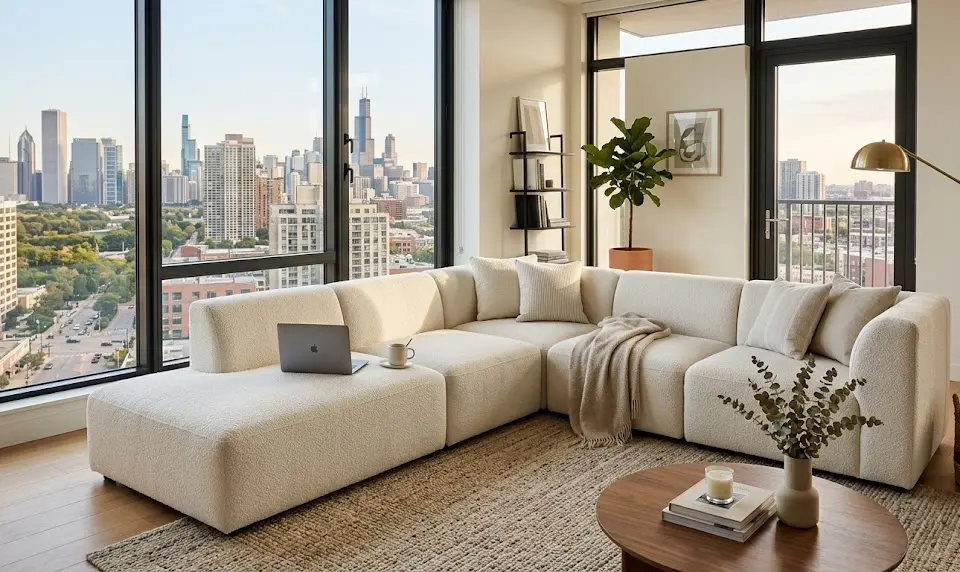
Key Takeaways
- The modular sofa market in the US alone is worth $2.7 billion in 2024, with a 28% CAGR projected through 2033—driven by buyers wanting customizable, space-saving seating (Research Report).
- Top buyer complaints include confusing module counts, heavy and awkward units, tricky removable covers, and high-maintenance fabrics like bouclé.
- The best picks feature simple modular joinery, lightweight frames, transparent piece counts, and truly user-friendly removable cover systems.
- Market snapshot — why modular sofas and low-profile sectionals matter in 2024
- Why low-profile sectionals are rising (and who should choose them)
- Top real-user complaints and negative experiences (so you know what to avoid)
- Durability & maintenance: removable covers and bouclé vs. traditional sectionals
- The top 3 customization features buyers expect but often find missing
- Price ranges mid‑2024 — what entry, mid, and premium include
- Which leading brands fall short on adaptability — common failure modes
- Technical specs and design hallmarks of the best modular sofas
- Buyer checklist — how to evaluate modular sofas in-store and online
- Shortcase recommendations — best use-cases and purchase scenarios
- Next steps: specs to ask suppliers and red flags to avoid
- FAQ
Market snapshot — why modular sofas and low-profile sectionals matter in 2024
Flexible living is no longer optional—it’s the new norm. As of 2024, the US modular sofa market alone commands an estimated $2.7 billion, while the global modular furniture segment has soared to nearly $84.5 billion, supported by a projected 28% annual growth rate through 2033.[Source]
Urban and suburban homeowners now prize seating that adapts fast to shifting layouts, more at-home work, and small-space demands.
Modular sofas aren’t just a trend—they’re a necessity for buyers seeking value, reconfigurability, and contemporary design.

The premium segment is surging, with North American and European buyers favoring direct-to-consumer (DTC) and luxury brands that deliver on customization and clean aesthetics. With remote and hybrid work driving more time at home, investing in the right modular sofa isn’t just about looks—it’s about daily flexibility and low-stress living.
Why low-profile sectionals are rising (and who should choose them)
The low profile sectional is on a sharp upswing as small-footprint layouts become standard in cities and even in modern suburban builds. Research confirms buyers want lighter silhouettes, clean lines, and seating that fits both compact open-plan lofts and tight family rooms.[Source]
What’s different about these? Shallow seat depths (usually 33 inches or less), lower back cushions, and feet that keep the frame above the floor for an airy feel. These sectionals give small rooms more visual space, pair well with floating furniture or accent chairs, and allow for a wider range of traffic patterns.
If your main concern is maximizing seating without crowding, or you prioritize a minimalist look and adaptability in living rooms or home office nooks, the low-profile sectional is a best-fit model—especially for households likely to reconfigure rooms as kids or roommates come and go.
Top real-user complaints and negative experiences (so you know what to avoid)
When you dig into actual buyer reviews and returns, a few recurring themes dominate across major market players:
- Confusing modular systems: Many custom modular seating setups advertise endless flexibility but ship with poorly documented module counts or require costly add‑ons for simple configurations.
- Weight and bulk: Users frequently complain that modular units or low-profile sectionals are much heavier and bulkier than expected—making delivery, rearrangement, or moving them around the house a hassle (real user examples).
- Removable cover headaches: Removable covers sound amazing—until you need to actually get them back on straight, or deal with covers that slip, bunch, or show finger marks after wash/delivery.
- Bouclé maintenance: This on-trend fabric pills, sheds fibers, and typically requires delicate hand cleaning—a recurring frustration for families or pet owners.
Choose brands and models that publish straightforward assembly diagrams, handle module labeling (or color coding), and offer plenty of real-user photos/videos showing assembly and actual living-room use.
Durability & maintenance: removable covers and bouclé vs. traditional sectionals
The removable cover sofa is often pitched as a game changer for long-term value. In practice, results are mixed. Some systems use cleverly engineered zippers and anchor points—making covers easy to remove, align, wash, and refit. Others have loose-fitting covers that slip during use or after cleaning.
Bouclé modular couch options look sharp and contemporary, but be realistic: user data routinely highlights pilling, color fade, and persistent “fuzzies.” For busy homes, look for stain-resistant synthetic blends or preshrunk cotton covers, and always check maintenance instructions before committing—especially with removable cover sofas.
Conventional upholstery (leather, twill, denim weaves) may offer a longer lifespan with less frequent cleaning headaches, but lack the future-proof flexibility that modular covers make possible.
The top 3 customization features buyers expect but often find missing
Here’s what truly design-conscious, adaptability-minded buyers demand (and what’s frequently absent at checkout):
- Clear, modular joinery and documented piece counts: If you can’t confirm how many pieces, which module does what, or what configuration upgrades cost, shop elsewhere.
- Lightweight, moveable modules and scalable systems: Nobody wants to wrestle furniture through tight doorways, and heavy, overbuilt frames kill the “easy reconfiguration” promise.
- User-friendly removable covers and modular fastening: Seek robust fastening (industrial-strength Velcro, covered zippers) and clearly labeled orientation tags to avoid alignment issues.
Insist on a test—either in-store or via user demo videos—before buying any custom modular seating system.
Price ranges mid‑2024 — what entry, mid, and premium include
Modular sofa pricing varies by configuration size, upholstery style, and branded customization. Here’s a quick breakdown:
| Tier | Typical Price Range | What’s Included |
|---|---|---|
| Entry | $800-$1,800 | Basic modular units (3-4 seats), simple fabric, glue-&-snap joinery, usually no removable covers |
| Mid | $1,800-$4,500 | Expanded layouts (up to 7 seats), washable synthetic covers, labeled modules, some chaise/recliner options |
| Premium | $4,500-$12,000+ | Top fabrics (bouclé, Italian leather), smart joinery, robust removable covers, in-home delivery, extra modules, advanced upgrades (double-chaise, power recliners) |
Be wary of hidden add-on fees for extra connectors, cover sets, or premium upholstery upgrades. North American demand is skewed toward these upper tiers—so expect a top-heavy market focused on high-end, truly customizable options.[Sectional Sofa Research]
Which leading brands fall short on adaptability — common failure modes
Even established brands like IKEA, West Elm, Joybird, Article, Pottery Barn, Lovesac, CB2, Wayfair, Room & Board, Made, Crate & Barrel, and Sactionals—each called out in industry coverage—show recurring pain points around:
- Complex or confusing configuration and ordering process
- Heavy or awkward modules that defeat easy rearrangement
- Poor or ambiguous upgrade paths (unclear if you can add on or change modules down the road)
- Expensive add‑ons for covers, joiners, or replacement pieces
Rather than assume a top name means true adaptability, always verify how modules are joined, whether expansion is truly “plug and play,” and if support for extra covers/spare parts is practical and reasonably priced. Reading customer reviews on manufacturer sites (see direct user feedback) gives a better sense of real-world shortcomings and surprise costs.
Technical specs and design hallmarks of the best modular sofas
Standout modular sofa systems nearly always feature:
- Standardized module footprints (ex: 34×34 inch seats) for reconfigurability
- Lightweight but durable plywood/steel frames—each piece under 45lbs is ideal
- Positive lock joinery (snap, click, or industrial-grade Velcro vs. basic plastic links)
- Labeled or color-coded modules for easy setup and expansion
- Washable, zip-off covers with reinforced seams and failproof alignment tags
- Reversible or multipurpose modules (e.g., chaise that can flip sides, ottomans convertible to seats)
- Transparent documentation—modular manuals, configuration guides, and clear warranty/return policies

If your potential modular seating brand can’t offer this, keep shopping. Ask to see manuals or full configuration walkthroughs, not just the polished showroom setup.
Buyer checklist — how to evaluate modular sofas in-store and online
Online listings and showrooms often look perfect. To get clarity before buying a removable cover sofa, actively check:
- Module measurements—does each piece actually fit through your doors and halls?
- How joinery works—are connectors snap, click, or basic brackets?
- Sample removable cover—watch for fit, ease of reattachment, and fabric thickness
- Replacement policy—can you buy a single extra seat, arm, or cover in the future?
- Weight per module—aim for units under 45lbs for single-person moves
- All-in pricing—request a written quote listing all modules, connector fees, cover sets, shipping, and in-home assembly

A truly transparent brand won’t dodge these questions. If a sales rep hesitates or skips details on spares and upgrades, consider it a red flag.
Shortcase recommendations — best use-cases and purchase scenarios
Whether you’re a remote worker, parent, or style-first shopper, here’s how to map modular sofa types to real-life needs:
- Frequent reconfigurers: Look for lightweight, clear-label modular seating—skip brands with complicated joinery or unproven cover systems.
- Families and pet owners: Prioritize washable, stain-resistant removable covers and avoid bouclé modular couch models unless you’re okay with hand-pilling and touch-up work.
- Style-focused urban buyers: Low profile sectional designs pair well with accent chairs and floating furniture. Consider modular systems that offer chaise modules which can reverse orientation.
No matter your scenario, always negotiate for a spare cover set (even if it’s a bonus coupon) and demand to see documented expansion paths if you want your sofa to last as your space evolves.
For tips on other furniture upgrades, check our guide on living room makeovers with minimal spend.
Next steps: specs to ask suppliers and red flags to avoid
Before buying any modular sofa, get clear answers to:
- Precise module footprint—how wide/deep/tall is each unit (in inches)?
- Joinery/mechanism type—snap-locks, connectors, Velcro, or brackets?
- Can you add-on?—Is there published support for expanding your system (with prices)?
- Cover-care for bouclé—Is professional, machine, or hand-wash required? Is pilling or shedding covered under warranty?
- Module/cover replacements—How fast can spares be shipped? Are returns and repairs handled locally?
Insist on written specs and care policies. Complexity, vague expansion options, and “just trust us” answers are all red flags—move on if you can’t get everything in writing.
If you want more tips on budgeting for a broader remodel, our home improvement tips will help you plan ahead.
Conclusion
Choosing a modular sofa in 2024 isn’t about settling—it’s about demanding flexibility, documented quality, and transparent support that truly adapts with your home and lifestyle. By prioritizing user-friendly joinery, lightweight construction, and stress-free removable cover options, you sidestep the most reported frustrations and get years of adaptable comfort. Act now: map your layout, demo removable covers, and ask the right questions so your modular sofa becomes the smartest (not just the most stylish) piece you own.
Ready to start your search? Download our free configuration checklist or explore the latest modular solutions on our modular storage guide.
FAQ
What’s the biggest advantage of a modular sofa over a traditional sectional?
Modular sofas make it much easier to change your room layout, adapt to new spaces, and replace worn modules or covers without buying a brand-new sofa.
How often do removable covers need washing, and do they really last?
Removable covers should be washed every 2–6 months (more often for families/pet owners). Well-designed covers last several years, but always follow care instructions, especially for bouclé or delicate fabrics.
Is bouclé a smart choice for busy homes or pets?
Bouclé is visually popular but demands careful upkeep; it pills, sheds fibers, and isn’t very stain resistant—families or pet owners may want to opt for performance fabrics instead.
Are there any reliable direct-to-consumer modular sofa brands?
Brands like Article, Joybird, Lovesac, and Inside Weather consistently offer true modularity, but always scrutinize joinery, piece counts, and service before purchase.
How can I avoid expensive add-ons or surprise upgrade fees?
Always request a full written quote listing all modules, spare covers, connectors, and delivery/assembly. Watch for hidden costs in expansion or premium fabric options.
