

microcement backsplash is gaining traction with homeowners seeking seamless, waterproof updates for kitchens and bathrooms—especially when overlaying existing tile for dramatic style without the headache (or cost) of demolition. If you want that modern, grout-free look, or to avoid the mess and unpredictability of tear-out, here’s what you really need to know before making the leap.
Key Takeaways
- Microcement backsplashes offer a smooth, groutless finish and can be installed directly over old tiles, saving time and money on demolition.
- Costs typically run $13–$32 per square foot installed, with savings of $2–$5 per square foot by overlaying instead of removing tile (source).
- Proper surface prep and professional sealing are essential to avoid cracking, staining, or peeling—choose your contractor wisely and always demand a warranty.
- Why homeowners choose microcement backsplashes
- Real cost breakdown — microcement vs traditional tile
- The top installation failures homeowners report — and the exact steps to prevent each one
- How to apply microcement over existing tiles — a practical prep & inspection checklist
- Waterproofing and stain resistance — what microcement delivers vs tile + grout
- Application specifics — layers, method, and curing realities
- Lifespan and maintenance — realistic expectations
- Design limitations and finish problems to plan around
- How to choose a contractor and what to demand in the quote
- Top 3 gaps most competitor articles miss (and why they matter)
- Quick decision checklist / homeowner action plan
- FAQ
Why homeowners choose microcement backsplashes
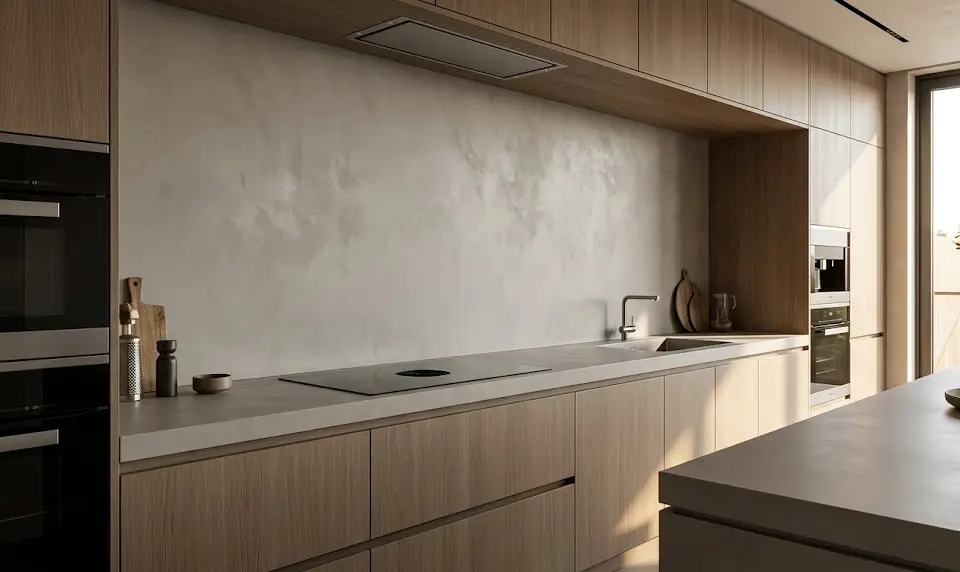
A microcement backsplash provides a seamless, richly textured surface that immediately modernizes any kitchen or bathroom. Unlike traditional tile, microcement backsplashes have no grout lines, so you get a truly continuous look—no joints, no visual “chop,” and none of the maintenance headaches associated with grout.
But the practical advantages may be even more compelling. Microcement can be applied directly over existing tile, drywall, or other hard, stable surfaces. That means you can sidestep the expense and disruption of demolition, plus avoid uncovering substrate surprises that often inflate renovation costs and timelines.
Research shows that this overlay ability is especially beneficial for mid-to-high-end remodels: you get a bespoke finish and design flexibility (color, finish, or subtle texture), with less risk of delays and dust.
Real cost breakdown — microcement vs traditional tile (materials + labor + overlay savings)
Let’s break down the real numbers side by side:
| Item | Microcement Backsplash (Overlay on Tile) | Traditional Tile Backsplash (Standard Install) |
|---|---|---|
| Materials | $5 – $12 /ft² | $1 – $5 /ft² (ceramic/porcelain) $15 – $20 /ft² (premium stone/designer) |
| Labor | $8 – $20 /ft² | $5 – $10 /ft² (add $2 – $5 /ft² for demolition/new substrate if needed) |
| Total Installed Cost | $13 – $32 /ft² | $6 – $15 /ft² (often higher for premium or stone tile) |
| Demo/Substrate Savings | Saves $2 – $5 /ft² (no tear-out) | Usually required unless overlaying |
On a small (20 ft²) backsplash, microcement overlay could be $260–$640 total installed, tile $120–$300 (or $400+ for premium tile). Larger backsplashes scale accordingly. While microcement per square foot is usually higher due to labor skill and materials, overlay savings add up—especially if demolition or new drywall is otherwise needed (see more).
For more tips on planning renovation costs, see our kitchen renovation checklist.
The top installation failures homeowners report — and the exact steps to prevent each one
Most complaints about microcement over tiles trace straight back to three root causes: rushed or improper surface prep, applying outside the recommended temperature range (ideal is 15–25°C), and cutting corners on sealing. Here’s a quick reference list of common pitfalls, matched with direct prevention tactics.
- Cracking/Delamination: Always check and repair loose or hollow tiles. Fill and level grout joints before priming. Never apply over movement joints or unstable substrates.
- Staining/Water Penetration: Insist on professional multi-coat sealing and request details on sealer type and manufacturer warranty—especially critical for a waterproof microcement backsplash.
- Surface Irregularity: Adequate sanding and careful trowel technique between coats; request sample panels or mockups from your installer.
- Color Variation/Fading: Pick experienced applicators; demand written color-match samples where exact shade is critical.
- Curing Issues: Keep room temperature stable (15–25°C) and avoid water splash/contact for several days after install.
For more about contractor vetting, read about how to compare home remodelers.
How to apply microcement over existing tiles — a practical prep & inspection checklist
If you want a successful microcement over tiles project, what matters is what happens before the trowel hits the wall. Follow this real-world prep and inspection list:
- Inspect all existing tiles for soundness. Tap-test (listen for hollow sounds) and look for cracks—replace or stabilize any loose tiles first.
- Fill all grout lines and joints flush. Any gaps or recesses must be filled with suitable filler and sanded before priming, or you risk “ghosting” and weak spots.
- Clean and de-grease thoroughly. Old backsplashes are often oily or soapy—residues will compromise adhesion. Use detergent, rinse well, let dry.
- Apply a proprietary tile-bonding primer designed for tile-to-microcement bonding. (Don’t skip this.)
- Request a sample adhesion test. Any reputable installer can do a patch area to prove the system bonds well before tackling the whole job.
- Only proceed if all above steps pass. If tiles are loose or hollow, demo is honestly the better call.

For a deeper dive on prepping challenging surfaces, see our tips for avoiding remodel mistakes.
Waterproofing and stain resistance — what microcement delivers vs tile + grout (and what installers must add)
Microcement is not inherently waterproof—but when sealed properly, it becomes a highly effective waterproof microcement solution, outlasting many grout systems in wet or splash-prone areas. The key is the sealer: it must be applied in multiple layers, allowed to cure, and be rated for kitchen or bathroom use (hydrophobic and stain-resistant).
Where tile’s weak spot is grout (which stains and absorbs water over time), microcement’s weak point is inadequate or poorly applied sealers. Ask to see technical data sheets, independent waterproof/stain resistance tests, and make sure your installer guarantees the sealer layer in writing (source). For everyday care, wipe spills quickly and avoid harsh solvents on sealed surfaces.
Want other modern, low-maintenance kitchen upgrades? Compare options like accent chairs for small kitchens to keep the whole space stylish and functional.
Application specifics — layers, method, and curing realities you should plan for
Professional microcement backsplash installs typically involve:
- One coat of tile-bonding primer
- 1–2 thin base coats (fiber-reinforced for strength)
- A finish coat (for texture and color/appearance)
- 2–3 layers of high-performance sealer (satin or matte)
The process is always hand-troweled—installer skill really matters. Unlike tile, each coat is thin (1–3 millimeters) and must dry before the next. Total project time for a seamless kitchen backsplash or microcement bathroom walls is usually three to five days, allowing for proper curing. Room temperature between 15–25°C is critical—too hot or cold causes curing issues and bond failures (source).
Plan for limited kitchen or bath use during curing—don’t rush back to cleaning or heavy use for at least 72 hours after the final coat.
Lifespan and maintenance — realistic expectations (and how overlaying affects them)
With correct installation and regular care, a seamless kitchen backsplash in microcement will last 7–15 years or more. Daily maintenance is simple: wipe spills, avoid abrasives, and use a neutral cleaner. Every 2–3 years, reapply the recommended sealer (much like waxing a wood floor) for best waterproof performance.
Overlaying over tiles does introduce more risk if the underlying substrate is unstable—the most common failure is delamination if tile joints aren’t filled or tiles shift over time. For this reason, warranties from your installer should specifically mention substrate adhesion and sealing longevity (see data).
Considering a bath remodel? See how local professionals compare on price and service.
Design limitations and finish problems to plan around
Microcement excels on large, smooth, flat areas (backsplashes, bathroom walls). However, visible finish issues are possible:
- Texture irregularity or “trowel lines” (installer-dependent—mockups help)
- Color variation or patchiness in poorly mixed batches
- Microcracking from temperature swings or substrate movement
- Edge chipping around sharp external corners (mitigation: metal trims or rounded edges)
- Challenges in extreme-wet zones (showers) without correctly specified waterproof microcement sealer
Tip: Always request a sample panel and detailed mockup before committing.

How to choose a contractor and what to demand in the quote
A successful microcement backsplash project starts with the right installer. Use this qualifications list:
- Portfolio with multiple microcement over tiles jobs—ask to see real before/after photos
- References from clients where overlays were done at least a year prior (to check adhesion, finish longevity)
- Written quote specifying substrate prep, number of coats, curing time, and sealer details
- Warranty covering both adhesion (substrate/delamination) and waterproof performance
- Sample board in your chosen color/texture
- Specific clauses for repairs if delamination or sealer failure occurs within warranty
Remember: The number one cause of failed overlays is installer error in prep/priming or inadequate sealing. Choose proven specialists only. For more insights, check out our advice on what to expect from a remodeler contract.
Top 3 gaps most competitor articles miss (and why they matter)
- Transparent apples-to-apples cost: Most ignore overlay savings and labor skill assumptions. Actual installed cost for microcement (including overlay savings) is $13–$32/ft², with demo savings of roughly $2–$5/ft² compared to tile. Always get detailed quotes.
- Step-by-step surface prep/testing: Delamination is nearly always prep-related. Demand written confirmation of patch-testing, filling grout joints, and priming quality before approving an overlay job.
- Waterproofing and stain resistance data: The sealer is what makes or breaks a waterproof microcement result. Ask for manufacturer-certified test reports (or warranty) before you sign.
Want more explainer guides? Browse our top small kitchen ideas for smarter upgrades.
Quick decision checklist / homeowner action plan
- Request at least three itemized quotes—with overlay-vs-demo pricing where relevant.
- Ask for a sample board and on-site adhesion test before work starts.
- Confirm a detailed plan for curing time and post-install care—allow at least three to five days out of service.
- Budget: $13–$32/ft² for microcement (overlay), $6–$15/ft² for standard tile (adjust upward for premium tiles).
- Require written explanation of prep/priming method and the exact sealer used, with warranty coverage for both adhesion and waterproof performance.
For a full budgeting approach, see our renovation cost analysis.
FAQ
Can you put microcement over existing tiles?
Yes, if the underlying tiles are sound and grout joints are filled and leveled before priming. Hollow, loose, or uneven tiles should be fixed or replaced first.
Is microcement really waterproof?
Only after professional-grade sealing in multiple coats. The quality and type of sealer determines water and stain resistance. Always request written specs and a warranty for use in kitchens and bathrooms.
How long does a microcement backsplash take to install?
Most jobs take three to five working days (including multiple coats and curing time). Avoid using or cleaning the backsplash until fully cured—usually 72 hours post-install.
How much does microcement cost compared to tile?
Installed microcement typically costs $13–$32/ft² (including overlay savings), versus $6–$15/ft² for standard tile. High-end designer or stone tile can exceed microcement prices.
How do I avoid cracking, staining, or peeling?
Hire a specialist, confirm substrate prep and grout joint filling, require written specs for priming and sealing, and ask for real project references.
